2024-11-20 · SMARTCAL: Choosing Tools and Calibrating Confidence
SMARTCAL was my first paper, written with Xiaodan Zhu and Lei Chen and published in the EMNLP 2024 Industry Track. We studied whether a language model can assess the usefulness of a tool call and how much confidence to place in it. Paper and authors
Why examine confidence in tool use?
Connecting search or code execution leaves room for mistakes in tool selection. A model may choose an irrelevant operation and still report high confidence. SMARTCAL examines this combination of misuse and overconfidence. Research motivation
For an illustrative example, suppose a question only requires calculating the days between two supplied dates. Searching for a person with the same name could introduce irrelevant information. When reviewing that step, I would ask what information is missing and whether the operation can supply it. This is an explanatory example, not an experimental case from the paper.
How SMARTCAL works
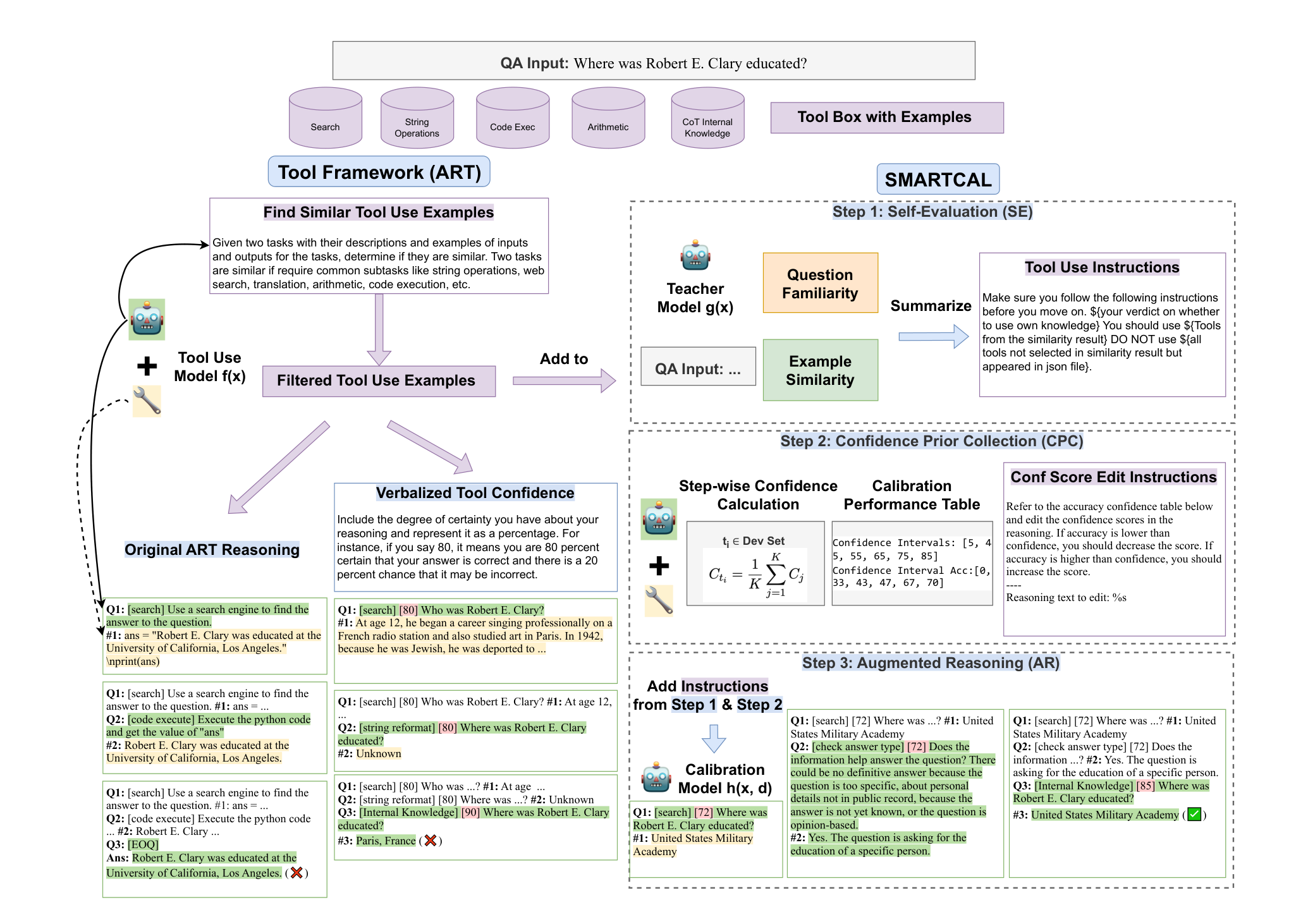
Figure 1 from Shen, Zhu and Chen (2024). ART and its confidence-reporting variant appear on the left; SMARTCAL appears on the right. Figure and method
Self-Evaluation (SE). A teacher model uses task familiarity and example similarity to prepare tool-use instructions: whether internal knowledge is sufficient and which tools from demonstrations fit the question.
Confidence Prior Collection (CPC). The tool-use model runs on held-out development data and reports confidence at each step. Scores are averaged per question, then binned against answer accuracy to form a confidence–accuracy lookup table.
Augmented Reasoning (AR). The tool-use model follows the instructions. A calibration model consults the lookup table and reasoning context, edits confidence assessments and produces the final answer. Here, self-awareness refers to these evaluation procedures; it does not establish human-like consciousness. Method, Section 2
The lookup table is an empirical reference from development data. My interpretation is that changing tasks or tools calls for checking whether that reference still applies.
What the paper found
Experiments covered ART and DSP on Mintaka, PopQA and Entity Questions. The table selects GPT-4 results to show how changes vary by dataset. These are the paper’s reported results, not new runs.
| Dataset | QA: ART | QA: ART + SMARTCAL | ECE: ART (V) | ECE: ART + SMARTCAL |
|---|---|---|---|---|
| Mintaka | 47.0% | 59.6% | 0.263 | 0.169 |
| PopQA | 55.3% | 55.7% | 0.261 | 0.201 |
| Entity Questions | 44.8% | 63.5% | 0.236 | 0.096 |
Values come from Tables 2 and 3, with QA fractions converted to percentages. QA is compared with ART; ECE is compared with ART (V), which elicits verbalized confidence. The two metrics therefore use different reference baselines. Original results
QA follows the paper’s relaxed EM rule, allowing containment matches between answers and labels. ECE measures the gap between binned confidence and empirical accuracy; lower is better, but it does not guarantee that an individual answer is correct. Improvements also vary by configuration: GPT-3.5-turbo’s PopQA ECE rose from 0.010 to 0.087. The appendix discusses how refusals, failed confidence extraction and default zero scores affect this metric. Metrics and anomalous cases
Boundaries to retain
The experiments used particular dataset subsets, model versions and prompts. More complex tasks with multiple reasoning paths remain to be tested. Extra model roles also add calls; I would not interpret accuracy gains as proof of optimal cost or transfer them directly to today’s models. Limitations, Section 7
For the implementation, start with ART_SM_CAL in the official repository. Its README lists OpenAI, Microsoft Bing and SerpApi credentials among the requirements. This overview describes the design and reported results; it does not claim a fresh reproduction of the complete experiments. Official code